Few people know that the tomb of Abigail Adams lies in a building nestled between a Subway sandwich shop and a nail salon. Sounds weird, right? But Oddities like these, and much more like them, are true of Quincy, Massachusetts; a metropolis of Greater Boston that constructed itself around its historical treasures over time.
Established in 1792, what began as one of the first settlements of the United States is now home to almost 90,000 people. As with any city, the sense of natural beauty gradually disappeared when never-ending construction projects transformed it into a massive concrete jungle devoid of color. Yet, Quincy’s national gems, including the United States’ first commercial railroad and Dunkin Donuts; look as pristine as ever, as if their immense value protects them from the graffiti and smog. The city's oldest graveyard lies directly in front of the Red Line Train station, which makes visiting a unique, and loud experience. A busy rotary was constructed around the saltbox houses of John Adams and his son John Quincy, and I'm sure the tour-guides have permanent sore throats from yelling over the loud honks and whizzing of traffic. It's a city of contradictions, perhaps a little odd to the tourist's eye but that is exactly what sets Quincy apart from other cities. Old and new is a theme seen everywhere, even in its demographics. Over roughly three centuries, the original population of entirely white British settlers has given way to a melting pot, in a sense. North Quincy has largely become an Asian-American neighborhood, and the shopping district there evidences as such, so much that many citizens have nicknamed it “The New Chinatown.” The many businesses cater to the Asian community, including a Chinese supermarket and a myriad of Asian influenced restaurants.
Still, Quincy has luckily retained much of its old fashioned All-American appeal. The city is still home to the nation’s longest running Flag Day Parade,and every spring children still decorate and gather round Maypole Hill, a place where pilgrims and Native Americans celebrated in drunken revelry. It’s longstanding traditions like these that make the city of Quincy truly special, and the experiences are just as sweet today as an apple pie coming out of your relative’s oven generations ago.
Photos courtesy of Google.
Here's a link to my personal Flickr with the abstract photos.
There is nothing more energizing than a community who's sense of excitement can be felt in the air. White River Junction, VT is a historically rich town that is undergoing one of the largest cultural rebirths in New England today.
With many buildings and storefronts being built in a time of steam locomotives, there has only been room to grow in recent times. A large artistic community has swept away the downtown filling the vacancy with niche shops and a broad range of restaurants and cafes. No worries though, you can still get a taste for the tracks at The Vermont Railroad Museum, located in the heart of downtown.
You can start off your day by having a traditional American breakfast in the Polka Dot Diner, whose size and shape are of an old train car. Trot down Main Street to the Main Street Museum, where a small collection of oddities that lays claim to hosting Elvis's Gallbladder can be found. Follow that up with a trip to the Tuckerbox Cafe, where you can sit in real cow hide chairs, drinking lattes out of large ceramic mugs, reminiscent of a more classic era in espresso.
Talk a walk around the corner to find Revolution, a high class used clothing store that offers not only a large vintage selection, but a whole line of custom designed clothing. If you are lucky enough you may even be able to catch one of their seasonal fashion shows at the Tip Top Cafe, an upbeat American bistro who's building was once a large bread factory .
While taking in the feeling of community that this town has to offer, be sure to check out the main building of The Center for Cartoon Studies, where you can see student's work on display. This is one of the only art schools in the US that focuses on the medium of Cartoon Art. You will gain a whole new vision and respect for cartoonists after seeing some of the amazing works in this unique learning institution.
Whether you are arriving to the beauty of the snow and the sound of the last trains rolling in or the warmth of the sun and the scent of the trees, this colorful Vermont town opens it's arms to visitors with its vibrant sense of renewal. It is the perfect getaway for a weekend trip that will keep you busy, allow you to relax, and leave with a sense of wonderment that will trace throughout your following days.
Horseheads, NY—Where nature is the highlight! by Katie
The town I grew up in located in upstate New York on the Pennsylvania border and nearly two hours from any major city, is unknown to most people. After hearing the name, Horseheads, I usually get a laugh and then “What?!” Horseheads does not have much to offer in terms of trendy malls, high rise buildings, and other sought after qualities of today’s booming metropolises, but it is a place of quiet natural beauty. Surrounded by rolling hills in the Finger Lakes region, the town offers a laid back atmosphere with friendly people who appreciate nature without much urban excitement.
Summer days growing up revolved around Seneca Lake, the largest of the eleven Finger Lakes. The days would float by while on a boat, water skiing, tubing, and swimming. With friends who owned cottages I spent most waking moments at the lake surrounded by the plush green rolling hills spotted with vineyards. Now that I am twenty-one I have been able to take advantage of fall in the Finger Lakes region where people from all around the world come to enjoy the foliage and visit the 35 wineries that surround the sparkling waters of Seneca Lake. Packages are offered throughout the year featuring special events at the wineries as well as limousine service to cruise the 38 mile shoreline and enjoy multiple wine, champagne, and beer tastings without worrying about driving.
At the base of Seneca Lake in the town of Watkins Glen, just 15 minutes up the road from Horseheads, lays many family activities. The town which is known for its tourist rush in the summer has a State Park where natural beauty is defined as water crashes through the side of the cliff. The park has hiking trails along the gorge following over 19 water falls ranging from 3 to 60 feet high. Watkins Glen is also home to an International Raceway which hosts all sorts of race events including NASCAR every summer.
A trail connecting Horseheads and Watkins Glen has recently been completed giving people the opportunity to walk or bike over 15 miles each way. In the winter many people enjoy numerous outdoor sports such as cross country or downhill skiing and tubing. Although Horseheads is “in the middle of nowhere,” the area is surrounded by natural beauty with plenty to do for adventurous and nature loving soles.
Of my various hometowns, perhaps the most unremarkable is the one in which I spent my teenage years, the one in which I have spent the least time, and the one of which I am nonetheless the most fond. The town of Ridgefield, Connecticut is more often than not recognized by neighboring towns’ reputations rather than its own. It is truly, as I said, a markedly unremarkable town; for a teenager, its only significant feature is the lack of any significant features. The most frequented establishment is Dunkin’ Donuts. The town hangout spot is Starbucks. Why the interest in coffee shops? I’m not even sure that there is one, aside from the fact that there are almost no other places for nearly 25,000 townspeople to gather and socialize. The town website offers a link of the top 100 things to do and places to go in Ridgefield: of those, only three items can actually be done and only two places can actually be visited within the town boarders. Of those activities, three involve visiting museums, and of those places, two are museums. And so, the coffee shop rendezvous are oftentimes not only the last but also the only viable option for local teenagers.
Few others in town tend to get together in such a fashion. A considerable portion of the Ridgefield community’s adult members is far too transient to sit for a long chat over a cup of coffee. There are three varieties of people well acquainted with Ridgefield, Connecticut: ones who travel through it daily on their way to work in Greenwich, Darien, New Canaan, or New York City; ones who choose to live there because of its close proximity to Greenwich, Darien, New Canaan, or New York City; and those who did not quite choose to settle there, but do so only because they cannot afford the costs of living in Greenwich, Darien, New Canaan, or New York City. This is largely due to the fact that even while Ridgefield’s median home value of roughly $750,000 is over twice the average value of other Connecticut residences, it pales in comparison to the average housing value of $1,650,000 in neighboring New Canaan, or $1,500,000 in neighboring Darien (City-data.com). In fact, the relatively affordable housing prices prompted developers to break ground for a condominium complex now known as Casagmo, located downtown, which sprawls over Ridgefield’s few sites of historical significance—the land on which the Battle of Ridgefield was fought during the Revolutionary war. Aptly named, the land is indeed one of jutting highlands and sloping lowlands, of glacially-formed ridges, and roads that are not only narrow but that also wind and curve and not infrequently take sharp, ninety degree turns in poorly signed areas.
Aside from its close proximity to a number of financial hubs, a large number of families are drawn to Ridgefield for the sole purpose of benefiting from the school district. Ranked 3rd best high school in the state, the 1,600+ students at RHS constantly perform well above average on standardized tests, including the more than 92% of students who score 3 or above on the over 800 AP tests that are taken by RHS students annually. With over 65% of the student body participating in school athletics, RHS sports teams have won 11 conference and state championships in the past 2 years alone, and boast a number of All-Conference, All-State, All-New England, and All-American award recipients (Wikipedia).
For lovers of the arts, Ridgefield may also hold some appeal. It is home of the Western Connecticut Youth Orchestra, the Aldrich Contemporary Art Museum, the Ridgefield Symphony Orchestra, and the Ridgefield Playhouse, the latter of which has hosted acts such as Blues Traveler, Arlo Guthrie, the Moscow Boys Choir, Brandie Carlile, among others. Eugene O’Neill once lived and wrote here, as did Howard Fast and Maurice Sendack. Poet Ira Joe Fisher currently lives and writes here, right down the street from my home, sometimes in my family’s kitchen.
An unremarkable town in more than a few respects, doing nothing in Ridgefield is nonetheless plenty satisfying to my own personal taste. The quaint, rarely busy main street with its locally owned bookstores, coffee shops, bakeries and cafés suit me far better than any sprawling shopping center or commercial plaza would. It may not be an overly visually or sensory stimulating town, but it is a quiet one, a place of relative calm and small-town New England charm. If you are looking for sites and sounds to keep you occupied and entertained, you might as well continue driving until you reach Greenwich, Darien, New Canaan, or New York City. But if you are looking for a place to breathe, the air here is clean and crisp and clear.
If you like history, you’ll love this town, for what could be more historic than a New England town older than the U.S.itself!
Between the ages of nine and twelve, my family and I lived in a small suburb located on the northern outskirts of the city of Hartford, CT. While living in Windsor, a very historic and culturally rich town, my family and I rented a beautiful home for the thirteen months out of the three years we lived there. Though the four bedroom house in which we lived, was much too small to occupy a family of seven, my father rented our home, so that his children would have the opportunity to grow up on the “good side” of town.
I remember the day my family and I moved in. All I could think about was the neighborhood I left behind in Plano, Texas-- where I had spent my early childhood years. But as our car slowly began to travel down a narrow, windy mysterious private lane and a beautiful big blue house appeared on the left, my heart sank, and I forgot all about life in Texas!
With a small lake in the back, and rolling hills in the front, 203 Harness Lane, stole my heart at first sight!
A child’s fantasy-- I spent my days climbing trees, and roaming forest grounds bare-foot.Occasionally, my neighbor and best friend, Cara Naylor and I, would pick blackberries from the hill top and bring them back to her placeto make what we swore was the most delightful blackberry jam ever!
During the winter months of the year, bundled up in our thick coats and oversized gloves, Cara and I would spend hour’s ice skating across the frozen lake which stretched across our backyards to the end of the street. With runny noises and pink cheeks, we’d end our day with a cup of hot chocolate at her place. After our exchange of secrets, story telling and tree carving in my favorite pine tree, we'd finally attempt some homework. Back then, days were never-ending--I would stay out in my baggy, tattered jeans from sunrise to sunset, in the town of Windsor.
One thing that I particularly loved about Windsor was that it was a very family oriented town. The town would hold annual fairs and carnivals in which families from all sections of town would attend! I loved seeing my friends from the opposite end of town in my neighborhood for the Northwest Park Country Fair, and enjoyed traveling to there’s for the Shad Derby!
Welsh Park.
Courtesy of Brendan O'Rourke.
“I think every kid from Windsor explored the river banks at Welch Park and stumbled across this view at some point.Remembering it is nostalgic, to say the least,” said Brendan O’Rourke, a former Windsor resident.
Welsh Park, one of Windsor's many public parks, offers its residents outdoor basketball and tennis courts, baseball fields, a playground set and a nearby public swimming pool.The Poquonock Market, a family run business, was walking distance from the pool and was the only place in town where you could purchase ice cream for 50 cents and airheads for ten! Did I mention the Farmington River flowed directly behind
the park?
Windsor was settled in 1633, making it older than the United States itself.
Located just five miles north of Hartford, Windsor covers a 31.1 square mile area right on the beautiful Connecticut River.
Windsor is conveniently located at an equal distance between New York and Boston. The Town is only minutes away from Bradley International Airport and is also located on a main-line railway that runs between Boston and New York. The
Connecticut Turnpike, the Massachusetts Turnpike and the New York Thruway are also easily accessible.
Though rich with culture and ethnic diversity, Windsor is also a very racially segregated town. About ten years ago, many middle class black families began to move out of the city of Hartford, into the town of Windsor, (as the town and city share a close border.)
As black families began to move into the town of Windsor, many white families began to flee. Property values then dropped, making homes in north Windsor more accessible to low income families, further driving down property values and potential tax revenue.
This systemic process is known as white flight and has occurred in a number of cities and suburbs across the U.S.
Restrictive racial covenants, and discriminatory housing markets have prevented blacks from moving into Poquonock— Windsor’s predominately white, upper-middle class neighborhood.
Windsor’s population according to Wikipedia, was estimated at 28,778 in 2005.
The racial makeup of the town is as follows:
White 65.12%,
African American 27.09%,
Native American 0.16%,
Asian 3.14%,
Pacific Islander 0.03%,
other races 2.09%, and
2.38% from two or more races
Hispanic or Latino of any race are 4.98% of the population.
Windsor High School, Windsor’s only High School, has 1471 students. The schools’ demographics for 2004-2005 were:
Black 46.2%,
White 41.1%,
Hispanic 8.8%,
Asian 3.8%, and
Native American 0.1%
Interestingly—though Windsor has a white population of 65.12%, only 41.1% are enrolled in Windsor’s public school system. Most white families send their children to one of the many private schools in Windsor or the surrounding area. Thus, 60% of Windsor High School is non-white.
The quality of public education in Windsor has declined substantially over the years, as Windsor’s most affluent and politically influential individuals vote to have their tax money go towards maintaining the Poquonock section of Windsor, leaving out funding for most public schools in Windsor, including Windsor High School.
For a period of about 100 years (1830-1930), woolen mills and paper mills located on the Farmington River in the Poquonock section of Windsor provided over 500 people with jobs.
(Google Images.)
Historically, Windsor's economy rested on tobacco farming and brickmaking. There was at one point, more than 40 brickyards in the town of Windsor. The last one vanished in the 1960's. The first tobacco crop was planted in the mid 1600’s. Today, amazingly-- many of the acres still stand, producing what Davidoff, a Swiss maker of luxury goods company referred to as “A nice Connecticut wrapper.”
In the 1970’s, Winchester was ranked as one of the top fifteen suburbs in the nation by the US Census. A sleepy bedroom community located just a fifteen minute train ride from Boston, it has changed little over the past few decades.
(Google Images)
With its quaint downtown, brick sidewalks, the common, and Wedge Pond, Winchester exudes classic New England charm. The town has fought the presence of chain establishments, and therefore most of its commerce is centered downtown, with unique restaurants, shops, bakeries, and boutiques. On a trip to Winchester center, D’Agostino’s deli, bakery La Patisserie, and Thai restaurant It Rains Fishes are can’t misses. Nick and Lizzie’s is a favorite shop among kids, and upscale boutiques French Lessons and Mad About Shoe merit a visit, even if only for window-shopping.
As one of the more affluent suburbs in the Greater Boston area, the median household income is over $100,000 and the average home price is approximately $800,000. Only 2.8% of residents are below the poverty level, compared with 9.9% in the state of Massachusetts (Citi-Data.com).
Winchester attracts many young families, as well as those who have lived there for generations. The pride and joy of Winchester may well be its school system. With five elementary schools, McCall Middle School, and Winchester High School, Winchester offers an excellent public education. Winchester’s public schools consistently rank near the top for MCAS scores. Winchester High School has over a 99% graduation rate, and approximately 85% of graduating seniors go on to four-year colleges (NEASC).
Winchester is a close-knit, family-oriented community, with annual events such as Town Day and the ENKA Fair. In the summer months, many residents unwind at the Country Club, the Boat Club, or the Swim and Tennis Club.
This small town of approximately 20,000 residents (2000 census) has had no shortage of famous residents, including cellist Yo-Yo Ma, Olympic gymnast Alicia Sacramone, Brad Whitford of Aerosmith, and Governors of Massachusetts Edward Everett, Samuel W. McCall, and John Volpe.
For any traveling journalist, one of the most important aspects of a fulfilling and memorable visit to anywhere is being able to interview, converse, and mingle with the citizens that live there and establish the rich culture of the place. Understanding the atmosphere of a place while visiting is always important; it helps us fathom how big the world really is, and how many different sets of values actually exist within our vast but limited biosphere.
Doing this can be especially hard while checking out the great land of America. The United States of America (known simply as America) is a large mix of many different cultures from around the world, so no matter how many times one visits one can never quite know everything one would like to know. You see, when America was first formed, it was formed under the basis of equal freedom for all peoples alike. It took quite a few renovations, but now the culture of America (often referred to by the locals as a "melting pot") is something created by people from all over the world.
It is impossible to attribute one main atmosphere with the entire country, one may visit one area and experience one culture and then one may visit another and experience something completely different. So the best way to really get to know the locals in America is to essentially pretend to be one.
What that means is this: because America is the land of many cultures, while visiting one should assume that one's own culture is as much a part of America as any other culture. Go to a local bar and talk about anything you want to, go shopping for things you are familiar with, eat somewhere suited to your taste; the moment you decide to make yourself at home in America, you become an American just like everyone else.
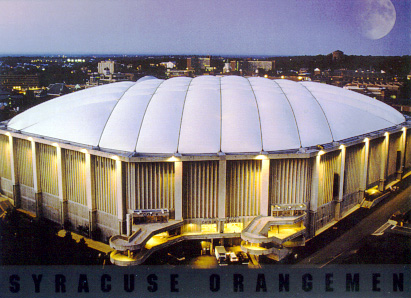
Congratulations on your decision to visit Syracuse! A sparkling jewel in the heart of New York State, this bustling metropolis boasts a population of 147,306, and a generous handful of relatively tall buildings. Among its landmarks are the art deco Niagara Mohawk Building, Syracuse University's recognizable Carrier Dome, which somewhat resembles a marshmallow, and its lesser-known cousin, the Manley Field House of LeMoyne College, whose likeness is closer to that of a burnt marshmallow. Though it was once known as the Salt City for its export of well, salt, along the Erie Canal, Syracuse's main export is now college basketball.
The city of Syracuse is often covered in a thick blanket of snow, sometimes beginning as early as October and ending as late as May, but underneath the snow lies a layer of ice, and underneath that lie many rolling hills, and perhaps a few buried cars. Unsurprisingly, the city is home to a thriving population of snowplows, and has several ski areas within a 40-minute drive.
Skaneateles Lake, one of the country's cleanest lakes, is 15 miles outside of Syracuse, and within city limits lies Onondaga Lake, which may or may not be filled with radioactive sludge after years of waste dumping by local industry. Though its waters are inhospitable to fish, swimmers, and most other living things, Onondaga Lake is home to the Syracuse City School District's crew team, which draws athletes from all four of the city's public high schools.
Further inland from the lake is Syracuse's downtown, full ofmuseums, bars, restaurants, and one really awesome tattoo and piercing studio. The original Dinosaur Bar-B-Que has a cult following, and rightly so: this motorcycle barbecue joint has live blues, waitresses that could kick your ass, and ribs well worth risking the ass-kicking. A twenty-minute walk away, University Hill is home to college students, old Victorian houses, and young families, as well as the hip Marshall Street and Westcott Street areas, complete with coffeeshops, vintage stores, figure drawing classes, an old theater, and a few lurking teen goths.
Harsh climates breed harsh peoples, and the extremely diverse indigenous people of Syracuse are impervious to cold. Schools stay open when the snowfall on the ground can be measured in feet, but Syracuse students do enjoy a number of windchill days when the windchill temperature is colder than -20, during which many idiot youths (my high-school-self included) often go sledding on the city's numerous hills.
Syracuse is also home to many a "That Guy": those elusive creatures within a town who are recognized by all, known well by few, made infamous in legends of their misbehavior, and who have probably slept with or sold drugs to one of your friends. That Guy is usually actually pretty nice, and should you choose to seek out That Guy, odds are good he will be chomping on a delicious vegan burrito at Alto Cinco, where the hipster factor is overshadowed by the glory of the fresh California-style Mexican food. Alto Cinco is worth a trip for the catfish burrito or jalapeno cornbread alone, so should you miss out on seeing That Guy, don't fret. That Guy is also one of Syracuse's major exports, so you're bound to bump into him somewhere eventually. If your hunger for people-watching and indulgent food still hasn't been slaked, head over to the New York State Fair, held every summer just outside Syracuse, where you can find legendary sausage sandwiches, fresh chocolate milk served a stone's throw from the cows who produced it, wine slushies, creepy butter sculptures, and some of the world's most entertaining and terrifying people-watching.
Idyllic it's not, but if you're looking to come home with great stories from a quirky midsize city with a dwindling population and garish hometown colors, Syracuse is definitely the right place. After all, wouldn't you expect to have fun in the place once inhabited by the likes of Grace Jones, L. Frank Baum, Carmelo Anthony, David Foster Wallace, and George Saunders?
Senior year is a reality check. I never realized how fast college would go by until I reached the point where I am almost done. It is difficult to try and adjust at first but after the first week freshman year Umass quickly became my home away from home.
1.) Tailgate at a Football game
Although the university has tried to "crack down" on the rules to enforce while tailgating at the football games, they are still a blast. It is a great social gathering in which the student body gathers together to share their school spirit.
2.) Attend the events during Welcome Back Week & Spring Week
Whether it is watching a movie at southwest beach or attending the spring concerts and barbecues, find something that appeals to you and go do it. What better way to break up your exams!
3.) Go to the Hatch at the Campus Center
If you like burgers and fries, I suggest going to Burger 101 at the Hatch. It is the first thing you smell when you walk in the door. The burgers are tasty and juicy while the fries are not greasy and have just enough salt on them to make my mouth water just talking about them.
4.) Attend a concert at the Mullins Center
You may leave with your ears ringing but the concerts I have attended at Umass have made my top 10 concert list:
Freshman year- John Mayer
Sophomore year- Dave Matthews Band
Junior year- Girl Talk & Lupe Fiasco
Senior year- Jay-Z & N.E.R.D
5.) Visit every Dining Common and try new foods
You can't judge which d.c. is the best without trying each one. They all offer their own selections of a sushi bar, creating your own stir fry, sandwich stations, pizza, pasta and salad bar.
Franklin- offers a great selection of vegan dishes as their specialty.
Worcester- always surprises me with their random chef specialties in the middle of the dining hall.
Hampshire- hands down my favorite d.c. when I want to go get food with a big group of people.
Berkshire- can be very overwhelming and crowded during the peak eating hours but definitely worth it for their giant chocolate chip cookies, fresh out of the oven in the dessert section.
Sandwiched between I-495 and I-93, Tewksbury, MA is an easily overlooked town as many people pass through it daily on their way to seemingly better things often found in neighboring Lowell or Boston to the south. However, most people don't realize that Tewksbury, with its unassuming small town charm, should not be so easily dismissed. History, activities for kids, and many restaurants make Tewksbury a great place to spend a day.
(Photography by Stephanie Geiser)
Tewksbury State Hospital was founded in 1852 and was originally established to help compensate for the large number of immigrants flooding into the state of Massachusetts. It also served as a facility for providing 24-hour care to patients who needed more treatment and supervision than their families could provide. Anne Sullivan, Helen Keller's teacher, was the most famous employee of Tewksbury Hospital. Today, the hospital campus operates as a rehabilitation center and houses the Public Health Museum. Also part of this campus is the Tewksbury Hospital Equestrian Farm (T.H.E. Farm for short) which primarily serves as an equine physical therepy center. However, what makes Tewksbury Hospital so intriguing today is its potential to become a photographer's playground. With its many interesting abandoned, reconfigured, or adapted structures, there are never-ending possibilities for photography no matter one's personal interests. When finished, take the kids down to Livingston Street which features the teen center, baseball and softball fields, a playground, and more.
After a busy day exploring, sample the best Tewksbury has to offer at any time of day. Hungry for breakfast? Stop by Vic's Waffle House. Be prepared to wait for a bit with some of the locals, but it's worth it. Can't decide between breakfast or lunch and like dining on the cheap? Deli King is the place. French's is great for take-out lunch or dinner as well as catering. They have a variety of soups, salads, and sandwiches. For something a bit fancier, Capellini's is a must, but go early so you can stop by Mirabella's Bakery before they close on the way back to I-495 for a cannoli or other Italian pastry.
Enjoy this small residential town for what it is: an unexpected find that is excellent to explore when you have a few hours or a day to explore.
South Hadley, Mass. is a relatively small town in Western Mass. and I've lived there with my parents and my younger sister since I was four years old. It's the home of the Tigers, the Village Commons, and Mount Holyoke College and is also one of the many towns that borders the Connecticut River.
For me, growing up in South Hadley was a great experience. I made some fantastic friends when I was really young, my parents became friends with their parents, and our families remain best friends to this day.
One of my favorite things about South Hadley is the Village Commons in the center of town. During the fall there's the Columbus Day Fair, and in the winter there's the Holiday Stroll, complete with warm apple cider, ice sculptures and santa on his sleigh. I always associate the Commons with the changing of the seasons, and because of this I enjoy walking around this part of South Hadley any time of the year. There are a bunch of cute shops and even more great restaurants, as well as the Tower Theaters, a small two-theater establishment that's a nice change from the standard huge cinema with stadium-style seating and 3-D offerings that we often see today.
Two of my favorite restaurants are Johnny's Bar and Grille and Tailgate Picnic. Tailgate has a ton of different deli and specialty sandwiches that are great for a quick lunch on the go. At Johnny's you can choose from a great variety of different options. The brie in puff pastry with raspberry sauce, sliced apples and garlic toast is the best appetizer they have. And I love the seared tuna salad. It has slices of seared rare ahi tuna that's crusted in black and white sesame seeds and it comes with edamame and a cold soba noodle salad. And look how pretty it is!
I graduated with a class of about 150 people, and by the time senior year rolled around, we were all pretty close. I think this is something that holds true to many of the South Hadley High graduating classes. Because it is such a small town, with a population of just over 17,000, I went to school with all of the same people growing up, which allowed me to make a lot of great friends.
South Hadley is also a great place to raise kids. I know that in my neighborhood, there were over a dozen kids that lived on my street and we were all within four years of eachother. In the summer we would play together all day and come back again after dinner for more. The great thing about the area is that you get to experience all the seasons in one place. You can enjoy the warm summer months cruising on the Connecticut River, hike up to the Summit House in Hadley for a great foliage tour during the fall, and ski or snowboard at any of the various mountains in the area. During the summer, you can even take a cruise on the Lady Bea, South Hadley's resident cruise boat that brings people up and down the Connecticut River. If you're lucky, you'll catch a glimpse of the bald eagles that live in one of the trees on the shore, and you'll definitely learn a thing or two about the history of the river.
Overall, South Hadley has a great New England feel and is a nice small town to raise a family in. It's surrounded by colleges, right in the 5-college loop which makes for some great opportunities for South Hadley students. So whether you're looking to have a great meal or enjoy any one of the four seasons, South Hadley is definitely a place to consider visiting if you're in the area.
Photos courtesy of TripAdvisor.com, mtholyoke.edu, thevillagecommons.com, southhadley.org, Alex Tillotson (me)


.jpg)